US Asylum Seekers

US creating border crisis by stalling asylum cases, advocates say

Rights groups say it’s ‘inconceivable’ US prioritised fortifying border over processing asylum cases expeditiously.

Baja California state Governor Francisco Arturo Vega is urging migrants and refugees taking part in the exodus to spread out to other ports of entry along the border instead of further concentrating in Baja California, “to alleviate what we have here and to try to address and manage it with more promptness, with more efficiency.”

The long wait

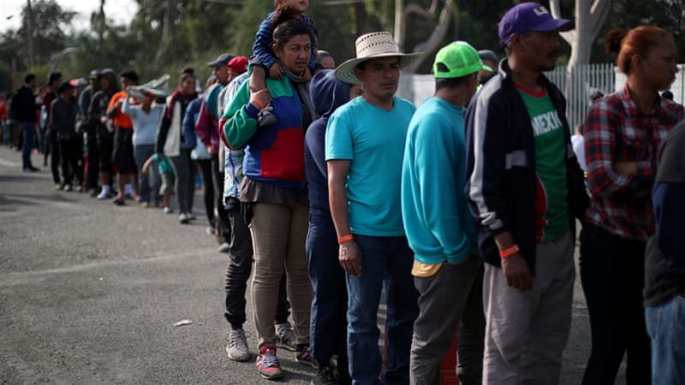
Tabsangh’s wait to enter the US came as thousands of Central Americans, part of a mass exodus, trickled into Tijuana area to sign up on the waiting list to seek asylum in the US.

‘They said leave or else’: Why a Honduran family is fleeing to US

Many told Al Jazeera they are fleeing violence, poverty or political persecution. The first of the highly visible groups, originally dubbed caravans and now a self-denominated exodus, left Honduras last month.

More than 5,000 migrants and refugees are now in Tijuana, and most of them are staying in a local stadium complex that is more than 2,000 people over capacity. Subsequent waves of the exodus, largely from Honduras and El Salvador, are making their way up through Mexico.


How you can help by supporting the International Rescue Committee (IRC):

 Trump administration “asylum ban” violates existing law

  • On Nov. 19, a U.S. federal court in San Francisco temporarily blocked the Trump administration’s new “asylum ban,” saying it violates existing law and would cause irreparable harm to immigrants.
  • The IRC is strongly opposed to the administration’s decision to deny safe haven to families like those in the Central American caravan who are seeking asylum.
  • This ban would not address the root causes of this crisis: Current levels of violence in Honduras, Guatemala and El Salvador are akin to those in the world’s deadliest war zones, and continue to increase.
  • The IRC is providing emergency support in El Salvador to families affected by violence. In the U.S., we are assisting families being reunified or released from federal custody, and those awaiting the outcome of their proceedings.
  • Read the IRC Statement

Immigration and Migration Oral History Projects/Collections

Bracero History Archive

National Park Service Ellis Island Oral Histories

University of Texas at El Paso Institute of Oral History

Northern Michigan University Italian-American Immigrant Oral History Catalog

Minnesota Historical Society, Minnesota Immigrant Oral Histories

Library of Congress, Interviews with Today’s Immigrants

Arab Immigration Oral History Digital Collection, University of Florida

PhilaPlace, Oral Interview Collection

Resources and Lesson Plans Related to Immigration/Migration and Oral Histories

Library of Congress, Teacher Resources-Immigration

The New Americans, PBS

National Park Service, Ellis Island–Oral Histories for Your Classroom

The Lower East Side Tenement Museum, Immigration History Lesson Plans

Bracero Archive, Teaching Resources

University of Minnesota Immigrant History Research Center Curriculum Plans

Archive of Immigrant Voices Lesson Plans

Teaching Contemporary Immigration with Oral History: Interview with Carlos Morales Lesson Plan

ASU Archives Collections

Arizona State University Archives Collections

University Publications
Archives has preserved over 15,000 volumes of official university publications, including general and graduate catalogs, yearbooks, campus newspapers and newsletters, magazines, sports media guides and programs, and research monographs.
Archival Collections
The ASU Presidential Papers include materials of each principal and president that document virtually every element of the educational and social experience at the university from 1885 to the present. Correspondence and research files from other administrative offices provide detail and perspective on many of the same issues represented in the Presidential Papers.
Manuscript Collections
Collections of papers from individual faculty members, administrators and alumni are an important source of information on the educational experience and the research mission of this institution. The Agnes Smedley Collection contains significant letters and publications produced by this socialist human rights activist in America and China. The collection is accompanied by the research materials of Dr. Stephen MacKinnon, her biographer. The papers of Kathryn Gammage, wife of President Grady Gammage, offer important information on the experience of one of ASU’s first families and Mrs. Gammage’s distinguished career at the ASU Development Office. A number of smaller collections of letters, scrapbooks, and diaries describe campus life from the days before air conditioning and the development of Phoenix as a commercial, industrial, and recreational center.
Photographic Collections
The University Archives Photograph Collection consists of approximately 30,000 prints, 80,000 negatives, and 6,500 slides that document many aspects of university history and campus life. Images of most university buildings and portraits of a number of ASU faculty, staff, and alumni are available. Many images depict changes in campus life and document educational, social, cultural, and athletic events.
Oral History Collections
University Archives established a continuing oral history program with the completion of the ASU Founding Deans Oral History Project. Interviews with the first dean of each ASU college and with the first Dean of the ASU Library are now available. Oral histories of many other members of the ASU community are planned for the future.
Audio-Visual Materials
Audio recordings and videotapes in various formats have also been preserved at University Archives. Audio recordings include renditions of the ASU Alma Mater by the Sun Devil Marching Band and performances by faculty and students from the School of Music. The inaugurations of presidents J. Russell Nelson and Lattie F. Coor have been captured on videotapes maintained with the Archives collections.

Visit https://lib.asu.edu/archives/collections for more information.

The Lawrence de Graaf Center for Oral and Public History (COPH)

“In the autumn of 1959, Orange County State College opened its doors in schoolrooms borrowed from Fullerton Union High School. A year later classes moved to temporary buildings erected on the site of what had been a Valencia orange grove. In 1968, the name changed to California State College, Fullerton, and permanent buildings began to grace the campus. In February of that year, Professor Gary L. Shumway taught the first course in oral history techniques and methodology.

This course launched the Oral History Program. Professor Shumway organized the innovative Oral History Program under the  sponsorship of the History Department, the Library, and the   Patrons of the Library. The program’s aim was to record and preserve the experiences of  ordinary citizens who had been participants in or eyewitnesses to significant historical events.

In the intervening years, Cal State Fullerton, has attained its university status and has celebrated its 40th anniversary. The Oral History Program, the fourth oldest program in the state, has grown as well. In 2002, it became the center for Oral and Public History (COPH).

Today the program encourages individual students, university classes, faculty, and independent researchers from beyond the CSUF campus to study and interpret information found in its archived interview tapes and transcripts, photographs, and other ephemeral documentation.”

The Center for Oral and Public History provides the following forms to their students. Courses are offered through the History Department. Classes deposit oral histories and photos into the archive for long-term preservation. Public history courses uses the archival materials in exhibition design. Visit coph.fullerton.edu/studentinformation/index5.php for more details.

COPH Workshop

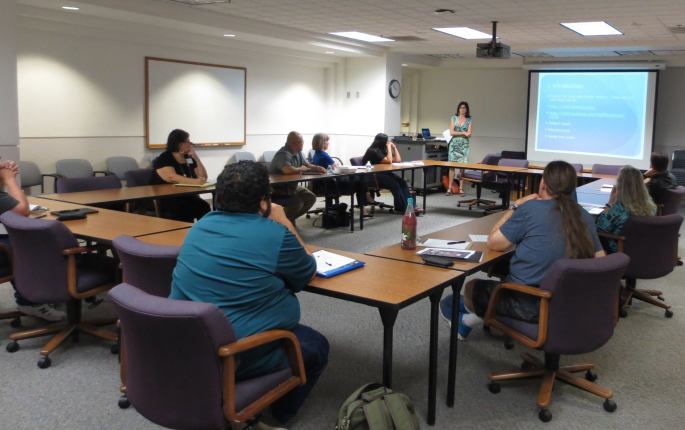
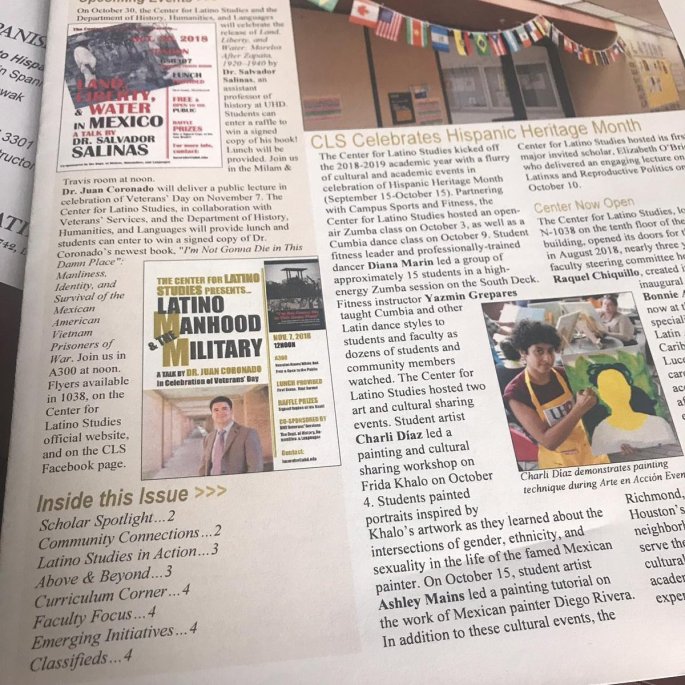
Veteran’s Day Lecture

Dr. Juan Coronado, SOHA Co-president, delivered a lecture at the University of Houston this past week to honor Veteran’s Day. His work focuses on Latino #Vietnam military experiences. View the review of his recent #book on the SOHA blog, sohanews.wordpress.com/2018/10/05/im-not-gonna-die-in-this-damn-place.

#military #historian #history #Texas #Houston #lecture #publication #oralhistory #narrative

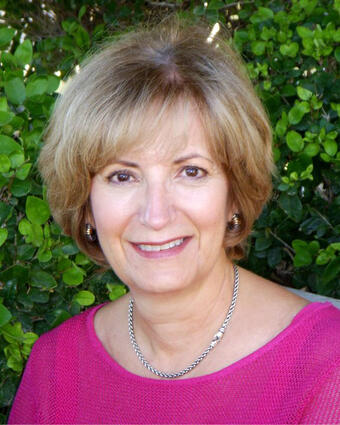
Barbara Tabach, SOHA Secretary and Newsletter Editor 

Barbara is the Project Director of the Southern Nevada Jewish Heritage Project of the Oral History Research Center at UNLV University Libraries. She has served as SOHA Secretary and Newsletter Editor since 2015.

Oral Historian, UNLV Oral History Research Center

Expertise: Collecting and organizing oral histories, Preserving family history, Las Vegas history

About

Barbara Tabach believes in the power of the human story and the value of collecting the voices that tell the stories. She is project manager and coordinator for the Oral History Research Center at University of Nevada, Las Vegas.

She collects oral histories and serves a leading role in the creation of two digital projects in UNLV Libraries’ Special Collections:

In addition, she has assisted with oral history projects of Las Vegas historic neighborhoods and longtime residents for the center.

Barbara is also an expert on techniques and methods for preserving personal and family histories. She has published two books on the topic: In Your Own Words and LifeCatching: The Art of Saving and Sharing Memories, co-authored with Polly Clark (Iowan Books).

Barbara received her bachelor’s degree in education from Drake University and did master’s studies in journalism at Iowa State University. She serves on the board of the Southwest Oral History Association.


Articles Featuring Barbara Tabach

Henry Kronberg
JAN 10, 2018

ARTS AND CULTURE

UNLV experts lead discussions during annual Las Vegas Jewish Film Festival Jan. 13-28

Visit https://www.unlv.edu/news/expert/barbara-tabach for more information.


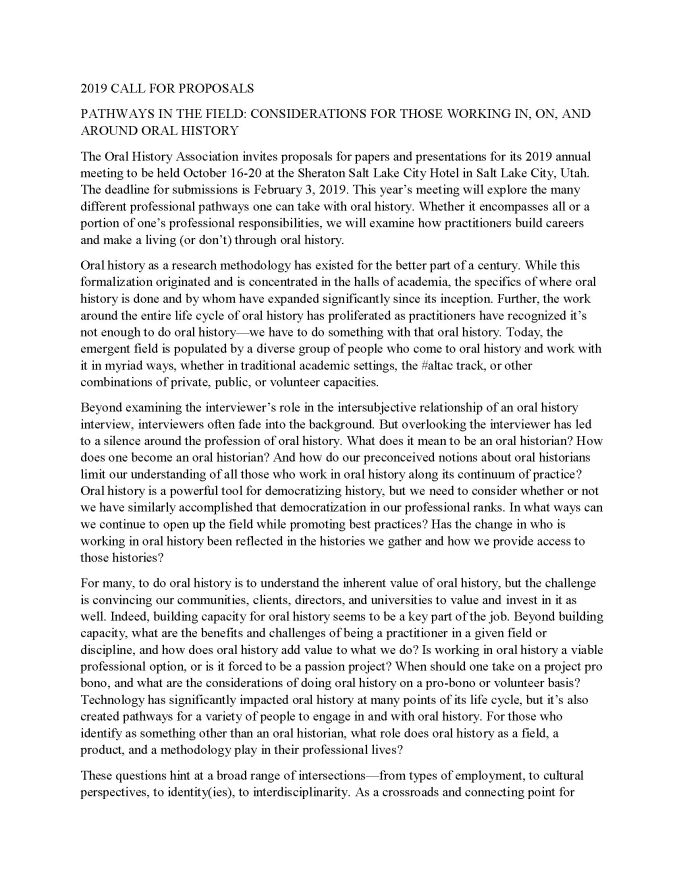
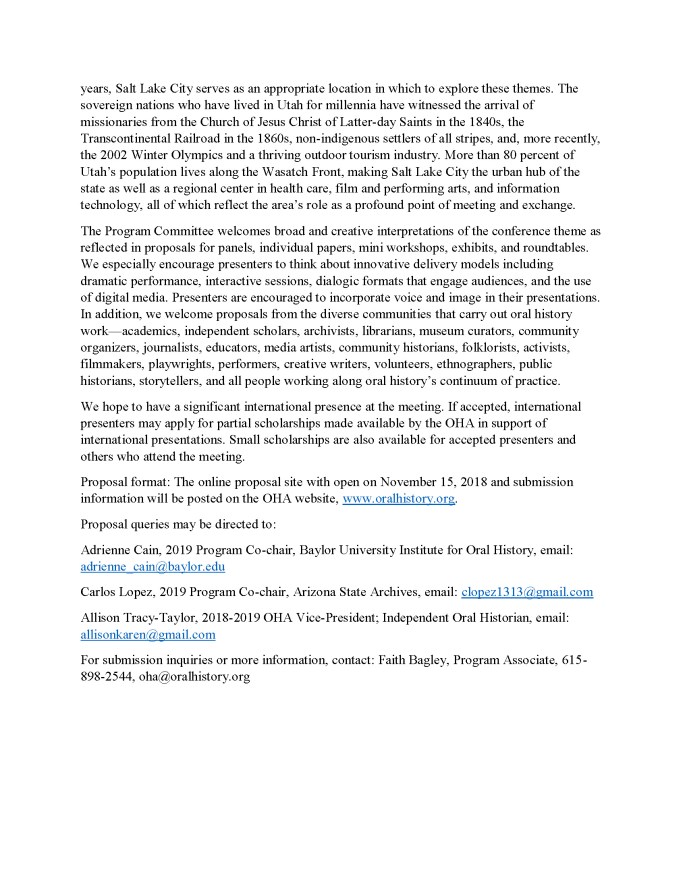
OHA 2019 Conference CFP

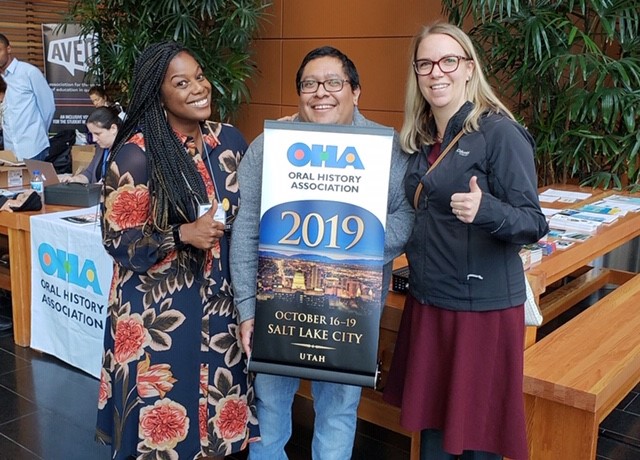
To the left of Carlos is Adrienne Cain of Baylor University, who us the co-chair of the Program Committee for 2019, and to the right is Allison Tracy-Taylor, OHA Vice President.
Long-time SOHA leader & Arizona representative, Carlos Lopez, is co-chairing the OHA 2019 Annual Conference in Salt Lake City. To the left of Carlos is Adrienne Cain of Baylor University. Adrienne is the 2019 Program Committee co-chair, and pictured on Carlos’ right, is Allison Tracy-Taylor, OHA Vice President.

2019 OHA CFP_Page_1


2019 OHA CFP_Page_2

Please share the 2019 OHA Call for Proposals PDF. SOHA will be partnering in this joint annual meeting. We hope to see you in Salt Lake City, Utah in 2019! Visit www.oralhistory.org/annual-meeting for more details.

Baylor University Institute for Oral History

About This Collection

“Since its founding in 1970, the Baylor University Institute for Oral History (BUIOH) has collected over 6000 interviews. The Institute has created transcripts of almost all interviews in the collection, and nearly 4000 of these transcripts are available to researchers and the public in our online collection as fully text-searchable PDFs. New draft transcripts of in-process projects are added monthly as work progresses.

In the fall of 2013, BUIOH began uploading audio files to accompany the transcripts already present in the online collection. This process is expected to continue through the end of the decade. Until then, many digital audio files may not be found online, but do exist on our private preservation server. To request access to an audio recording that is not online, send a request to BUIOH@Baylor.edu . Be sure to provide complete information about the name of the interviewee and the date of the interview.”

If you are looking for oral history project resources, check out their Style_Guide_May_2018 and Intro_Manual_2016.

Society of American Archivists Bootcamp

Visit the UCI site for a virtual tour.

Series Description

Join us for one week of Society of American Archivists Education courses at UC-Irvine and make progress toward your DAS or A&D certificate. The weeklong series includes 3 A&D courses and 2 DAS courses. Get a jump start on your certificate path with this series.

A&D and DAS Bootcamp #1938  [A&D, DAS]

Details

Mon, Nov 5, 2018, through Fri, Nov 9, 2018
University of California
Irvine, CA

Early-Bird Registration Deadline: October 9, 2018

Co-Sponsor: University of California, Irvine

Courses

Event Name Date & Time Instructors/Speakers & CEUs

Appraisal of Digital Records [A&D, DAS] #1939

Mon, Nov 5, 2018
9:00 AM – 5:00 PM

Mark J. Myers 

General CEU Credits: 0.75
Archival Recertification Credits: 5
A&D Foundational Tier: 1
DAS Foundational Tier: 1

Arrangement and Description: Fundamentals [A&D] #1940

Tue, Nov 6, 2018 –
Wed, Nov 7, 2018
9:00 AM – 5:00 PM

Pamela S. Hackbart-Dean 
Anne M. Ostendarp 

General CEU Credits: 1.5
Archival Recertification Credits: 10
A&D Foundational Tier: 1

Describing Archives: A Content Standard (DACS) [A&D] #1941

Thu, Nov 8, 2018
9:00 AM – 5:00 PM

Jacqueline Dean 

Archival Recertification Credits: 5
General CEU Credits: 0.75
A&D Foundational Tier: 1

Managing Digital Records in Archives and Special Collections [DAS] #1942

Fri, Nov 9, 2018
9:00 AM – 5:00 PM

Seth Shaw 

Archival Recertification Credits: 5
General CEU Credits: 0.75
DAS Transformational Tier: 1

About the A&D Certificate
The SAA Arrangement & Description certificate program allows archivists to gain more experience and knowledge in this single topic than is generally available in graduate archival programs. This approach provides archivists with extended descriptive training to expand the skill set they gained in graduate school, and it also can facilitate career shifts within the archival field (e.g., moving from public services to processing/cataloging). Taken as a whole, these courses provide an integrated programmatic framework for archivists and others at various levels within their institutions whose areas of practice include arrangement and description.

About the DAS Certificate
SAA is committed to providing education and training to ensure that archivists adopt appropriate practices for appraising, capturing, preserving, and providing access to electronic records. That’s why we’ve developed the Digital Archives Specialist (DAS) Curriculum and Certificate Program, designed to provide you with the information and tools you need to manage the demands of born-digital records. The DAS curriculum, developed by experts in the field of digital archives, is structured in tiers of study that guide you to choose courses based on your specific knowledge, training, and needs. You can choose individual courses—or you can take your learning to the next level by earning a Digital Archives Specialist Certificate from SAA after completing required coursework and passing both course and comprehensive examinations.

See https://saa.archivists.org/events/a-d-and-das-bootcamp-1938/907/ for more details.

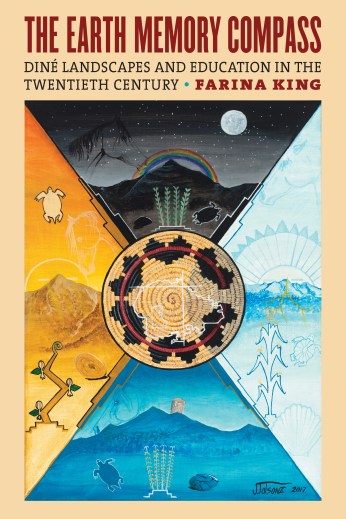
The Earth Memory Compass

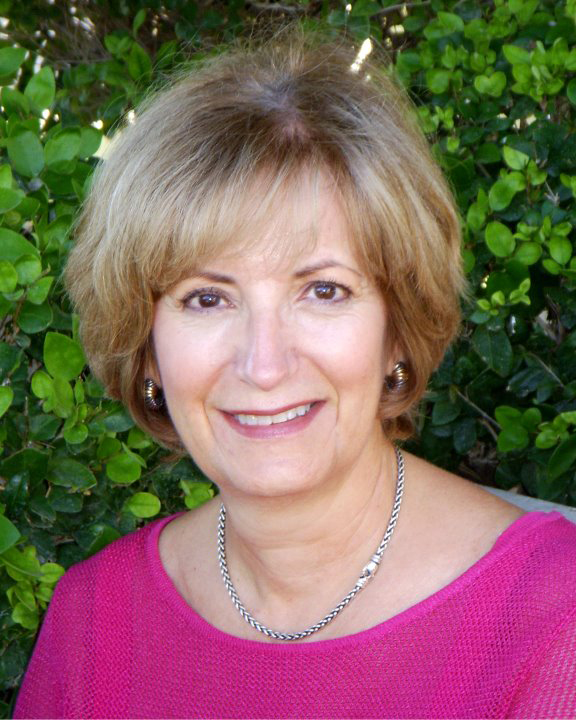
king.jpgCongratulations to Farina King, SOHA 2nd VP, for her recent book publication!
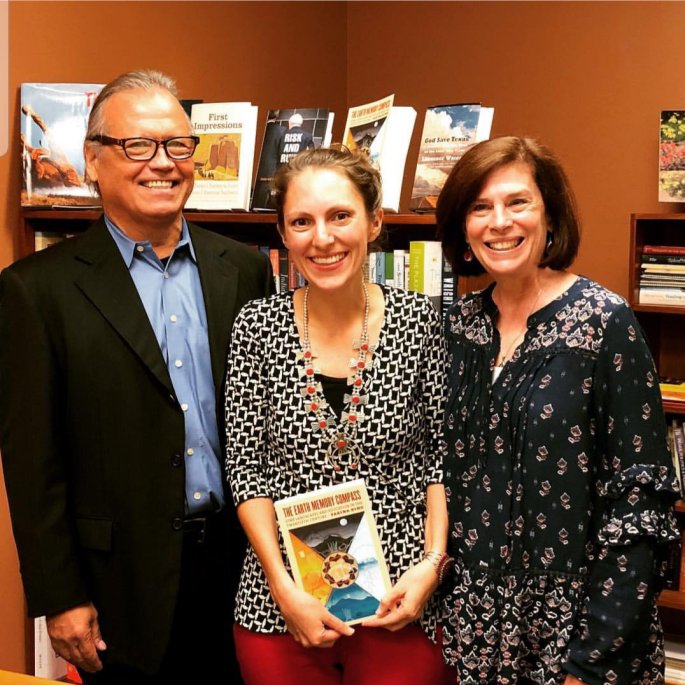
The Earth Memory Compass: Diné Landscapes and Education in the Twentieth Century

The Diné, or Navajo, have their own ways of knowing and being in the world, a cultural identity linked to their homelands through ancestral memory. The Earth Memory Compasstraces this tradition as it is imparted from generation to generation, and as it has been transformed, and often obscured, by modern modes of education. An autoethnography of sorts, the book follows Farina King’s search for her own Diné identity as she investigates the interconnections among Navajo students, their people, and Diné Bikéyah—or Navajo lands—across the twentieth century.

In her exploration of how historical changes in education have reshaped Diné identity and community, King draws on the insights of ethnohistory, cultural history, and Navajo language. At the center of her study is the Diné idea of the Four Directions, in which each of the cardinal directions takes its meaning from a sacred mountain and its accompanying element: East, for instance, is Sis Naajin (Blanca Peak) and white shell; West, Dook’o’oosłííd (San Francisco Peaks) and abalone; North, Dibé Nitsaa (Hesperus Peak) and black jet; South, Tsoodził (Mount Taylor) and turquoise. King elaborates on the meanings and teachings of the mountains and directions throughout her book to illuminate how Navajos have embedded memories in landmarks to serve as a compass for their people—a compass threatened by the dislocation and disconnection of Diné students from their land, communities, and Navajo ways of learning.

“Farina King’s study offers a passionate and thoughtful account of how the Diné, by holding on to their sacred ways of knowing and living, have withstood the long ordeal of educational colonialism. Beautifully written, bold in conception, and packed with intimate stories, this is a must-read for those interested in how indigenous peoples might maintain or rediscover ancestral identities.”

—David W. Adams, author of Education for Extinction: American Indians and the Boarding School Experience, 1875–1928 and Three Roads to Magdalena: Coming of Age in a Southwest Borderland, 1890–1990

“In engaging and readable prose, Farina King has produced a compelling autoethnography wherein she introduces readers to the concept of the Earth Memory Compass in order to get academics and laypeople alike to rethink the history of twentieth-century Diné educational experiences. In the process, she helps readers think about land, knowledge, and collective identity creation in ways that will help subsequent generations of scholars forge new work.”

—Erika Bsumek, author of Indian-Made: Navajo Culture in the Marketplace, 1868–1940

Critical to this story is how inextricably Indigenous education and experience is intertwined with American dynamics of power and history. As environmental catastrophes and struggles over resources sever the connections among peoplehood, land, and water, Kings book holds out hope that the teachings, guidance, and knowledge of an earth memory compass still have the power to bring the people and the earth together.

Published in Cooperation with the William P. Clements Center for Southwest Studies, Southern Methodist University

About the Author

Farina King is assistant professor of history and affiliate of the Cherokee and Indigenous Studies Department at Northeastern State University, Tahlequah, Oklahoma.

Information provided by: https://kansaspress.ku.edu/978-0-7006-2691-5.html