SOHA Membership

Hello from the Southwest Oral History Association! Please join or renew your membership today.

Staying involved with SOHA gives you access to our growing network of oral historians, archivists, storytellers and transcribers – from students to seasoned practitioners — who work together to share stories of real people and communities with the rest of the world. Your SOHA membership keeps you connected to other dedicated oral historians via our newsletters and conferences. 

As importantly, your membership supports our General Scholarships and Eva Tulene Watt Scholarships for Native Scholars as well as our Mini-Grants for local projects. These funds enable us to support the oral history work of college and university students and practitioners in local communities throughout our growing region. In addition, the scholarships and mini-grants enable recipients to share their work with you and other SOHA members at our annual conferences, an added benefit that has been greatly appreciated.  

We are very excited about the plans for our 2018 conference, starting with the theme Elevating Voices: Oral Histories of Resilience and Unity. It is scheduled for Friday, April 27 through Sunday, April 29 on the campus of California State University, Fullerton, with very reasonable and comfortable lodging available right next door at the Fullerton Marriott. And the even better news is that there is still time for you to submit a proposal! See the  Call for Proposals for more information about participating in the conference. We look forward to seeing you in Fullerton! 

Please join or renew your membership now. You can log on to www.southwestoralhistory.org and click on the “Mission and Membership” tab. That takes you to the online link via the green “Membership” box. Or you can download the Membership form and mail it to the SOHA office at:                             

Southwest Oral History Association

University of Nevada, Las Vegas

4505 South Maryland Parkway

Box 455020

Las Vegas, Nevada 89154-5020

Thank you very much for your continued support. You make the SOHA network strong and vital. If you have any questions or concerns, please feel free to contact us at soha@unlv.edu or at 702-895-5011.


Sincerely,

Marcie M. Gallo and Juan D. Coronado

SOHA Co-Presidents


SOHA OFFICE

University of Nevada, Las Vegas

Box 455020
4505 S. Maryland Parkway

Las Vegas, NV 89154-5020  

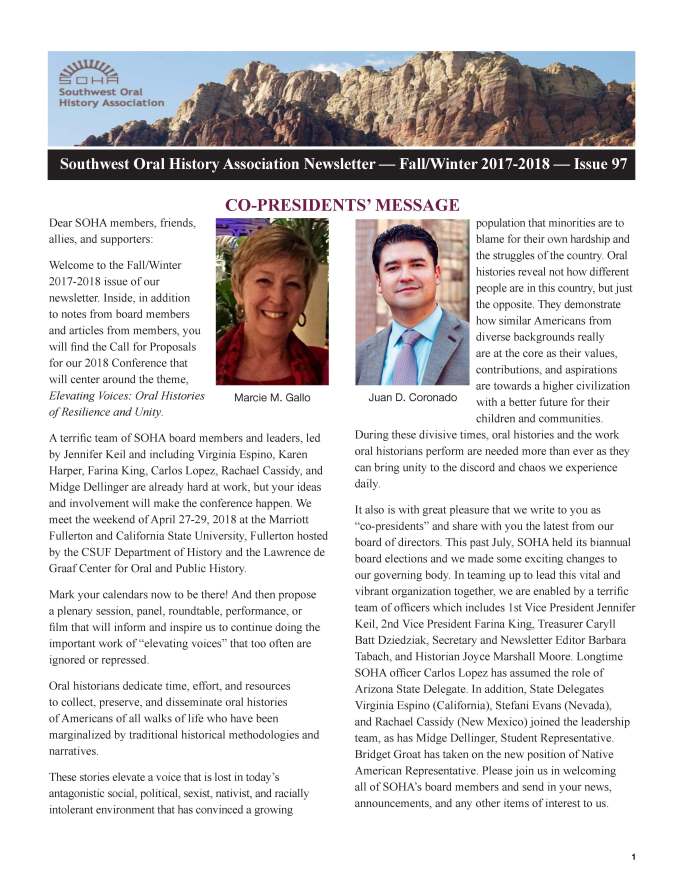
SOHA Fall/Winter 2017-18 Newsletter

Fall-Winter 2017-18 SOHA Newsletter_Page_01.jpgGreetings! Our Fall/Winter 2017-18 newsletter is now available! Please read the PDF version here. We hope to see you in Fullerton at our 2018 Conference! Share widely and enjoy!
2018 SOHA Conference

Greetings SOHA Members and Supporters!

We are currently accepting proposals for presentations at the 2018 Annual SOHA Conference in Fullerton, California. This year, we are partnering with CSU, Fullerton and they have graciously allowed us to use their hi-tech classrooms for the conference. So far, we have received proposals for many outstanding presentations, but there is still plenty of room for more. I know most of you are in the middle of projects that we all would love to hear about! Proposals are due to soha@unlv.edu by November 20, 2017.

Not sure what to present? We’re looking for a number of unique presentations to highlight the versatility of oral history. The conference is open to performances, documentary films, digital projects, posters, discussions, round tables, and anything else you can think of. 

If you have any questions at all about the conference or the submission process, please contact us at soha@unlv.edu or at 702-895-5011.

Hope to see you in Fullerton!


SOHA OFFICE

University of Nevada, Las Vegas

Box 455020

4505 S. Maryland Parkway

Las Vegas, NV 89154-5020  

The Oral History Center at UC, Berkeley

Introductory Workshops

Our next introductory workshop will be held on Saturday, February 24, 2018. We are now accepting applications.

The one day introductory workshop tuition is $125 and is designed for people who are interested in an introduction to the basic practice of oral history and serves as a companion to our more in­-depth Advanced Oral History Summer Institute held in August.

OHC historian Shanna Farrell leading the Spring 2015 Intro to Oral History Workshop

This workshop focuses on the “nuts-­and-­bolts” of oral history including methodology and ethics, practice, and recording. It will be taught by our seasoned oral historians and include hands­-on practice exercises. Although space is strictly limited, everyone is welcome to attend the workshop, including community-­based historians, teachers, genealogists, public historians, and students in college or graduate school.

If you have specific questions, please contact Shanna Farrell at sfarrell@library.berkeley.edu. Visit http://bit.ly/IntroWorkshop2018 for more details.

ASU Exhibit Opening

“Our Stories” Exhibit Opening


You’re Invited! RSVP here: 

https://t.co/3bmZGEnVUm

The students of HST 325: Immigration and Ethnicity in the United States cordially invite family, friends, and faculty to the opening of their exhibit “Our Stories” at Hayden Library, Room C2 at Arizona State University in Tempe on Thursday, November 16 at 6pm.

Come hear students discuss their migration/immigration histories, listen to the oral history interviews they conducted with family members, and explore their family history research discoveries!

Refreshments will be served. RSVPs are appreciated but not required.

All are welcome!


¡Está invitado!

Los estudiantes de HST 325: Inmigración y Etnicidad en los Estados Unidos invitan cordialmente a la familia, amigos, y profesores a la apertura de su exhibición “Nuestras Historias” en la Sala C2 de la librería Hayden en Arizona State University, en el campus de Tempe el jueves, 16 de noviembre a las 6 p.m.

Vengan a escuchar a los estudiantes hablar sobre sus historias de migración/inmigración, escuchar las entrevistas de historia oral que realizaron con los miembros de la familia y explorar las pruebas que descubrieron a través de la investigación de historia familiar.

Se servirán refrescos. Los RSVPs son apreciados pero no requeridos.

¡Todos son bienvenidos!


Adigu waad ku casuumayaa!

Ardayda HST 325: Qaxoontiga iyo Qowmiyadaha ku nool Mareykanka ayaa si xushmad leh ugu martiqaaday qoysaska, saaxiibada, iyo macallimiinta furitaanka bandhiggooda “Sheekooyinkeena” ee Hayden Library, qolka C2 ee Jaamacadda Arizona State University ee Tempe Khamiistii, Noofambar 16 waqdiga markuyahay 6pm.

Kaalay maqal ardayda ka sheekee taariikhdooda socdaalka / soogalootiga, dhagaystaan ​​wareysiyada taariikhda ee afka ah ee ay la sameeyeen xubnaha qoyska, iyo sahamiyaan baadhitaanada taariikhda qoyskooda!

Cabitaan iyo cunto ayaa lakenaya naah. RSVPs waa la qiimeeyaa looma baahna.

Dhammaan waa la soo dhoweynayaa!

Community Voices: Celebrating the Hands that Feed Us

  • By Gabriel Thompson
  •  

  •  via 

    Bakersfield.com

    Gabriel Thompson

    In August of 1936, a young writer named John Steinbeck set out in an old bakery truck to capture the lives of California’s migrant farmworkers. With a notebook in hand, he toured the San Joaquin Valley, spending much of his time in the Bakersfield area, which would lead to his classic 1939 novel, The Grapes of Wrath.

    Steinbeck’s book shocked the country. He revealed the hardships faced by migrant farmworkers, who made just enough money to keep moving along, and who struggled with one crisis after another — from having their wages stolen to being unable to find safe housing.

    As I learned last year, many of those crises continue. For several months, I traveled the state to meet with current and former farmworkers, who told stories about their lives in the field. “The world needs to know us better,” one farmworker, Roberto, told me. “No one comes out here; no one knows what we go through.”

    Roberto has worked in the fields for 20 years, much of it spent following the grape harvest between Coachella and Bakersfield. In 2005, after his 16-year-old son nearly died of heat stroke while harvesting grapes, Roberto became an advocate and traveled to Sacramento to testify in support of new heat regulations. Today, California is the only state with such rules, which protect not just farmworkers but everyone who works outdoors.

    Roberto is one of 17 people featured in my new book, “Chasing the Harvest: Migrant Farmworkers in California Agriculture.” It is an oral history collection from the fields, allowing people — farmworkers, advocates and growers — to tell their stories in their own words, making each entry both intimate and engrossing. The narrators, who are aged 17 to 77, live as far south as the border city of Calexico all the way up to Stockton. Several, like Roberto, have spent years harvesting crops around Bakersfield.

    It is a punishing occupation that doesn’t pay much: the median annual income for California farmworkers is $14,000. Farmworkers contend with wage theft, pesticide exposure and sexual harassment. A study of seven agricultural communities in California found that 10 percent of farmworkers lived in what researchers called “informal dwellings” like garages, sheds, barns and abandoned vehicles. Formal dwellings aren’t always much better. Families double or triple up in apartments, stuff into sweltering trailers, and make homes out of primitive labor camps.

    The narrators in the book talk frankly about such challenges. But they also share stories of hope and triumph. This might seem strange to readers who think of farmworkers only as exploited, vulnerable and miserable. Statistics do a good job of painting that picture, and they are indeed real. But the statistics miss a lot, too. They miss the joys that farmworkers also have: the pride in their work, the camaraderie of a crew, the tight-knit families, the feeling of deep satisfaction that comes, as one narrator put it, from being in “a beautiful struggle.”

    “Look at my hands,” Roberto told me, an hour into our conversation. Two fingernails were busted, there was a cut on his hand, and the calluses on his palms were hard as bricks. “These are the hands that feed this country.” He had a wide smile on his face. His is an important occupation, and he knew it.

    There are 800,000 farmworkers in California, who make up one-third of the nation’s agricultural workforce. We rarely get the chance to hear from them, but this book allows you to invite 17 people into your living room and listen to them share details about their hopes and fears, their joys and hardships.

    Even better, next week you can meet some of the farmworkers in person in Delano. On Wednesday, Oct. 25, from 6 to 8 p.m., we will host a panel discussion with farmworkers from “Chasing the Harvest,” which will also celebrate the legendary UFW organizer Larry Itliong. The event, which is sponsored by the Social Justice Institute of Bakersfield College, will be held at Robert F. Kennedy High School, located at 1401 Heitt Avenue. And if you come at 5 p.m. with a family historical artifact — whether a photo or letter — Digital Delano will record your story.

    Gabriel Thompson is a freelance journalist and author, whose most recent book is Chasing the Harvest.

    OHA Webinar

    Documenting Your Community: Planning Skills for Oral History Projects

    Event Date: Friday, November 3, 2017
    Event Time: 10 a.m. Pacific, 12 p.m. Central, 1 p.m. Eastern Time
    Event Length: 60 minutesPresenters: Jeff D. Corrigan, California State University Monterey Bay
    Mary A. Larson, Oklahoma State University

    Host: Kristine Navarro-McElhaney, Arizona State University

    Questions may be directed to: jcorrigan@csumb.edu

    Description: The purpose of this webinar is to help people who are at the very earliest stages of planning community oral history projects determine what work will be required and what resources they will need. This one-hour session will cover the basics of project planning and give participants a sense of what skills and resources are necessary for developing and sustaining a community oral history project. The webinar will include sample planning templates that participants can customize.

    Visit https://docs.google.com/forms/d/e/1FAIpQLSdia888ePBisX-txzY0MNEejOtf4aqKsFKGXPHwZQy-IoNGdA/viewform to register.

    Eva Tulene-Watt 2017 Awardees

    Eva Tulene-Watt awardees Angelo Baca and Teresa Montoya discuss ongoing efforts to save Bears Ears sacred land in southeastern Utah
    Eva Tulene-Watt awardees Angelo Baca and Teresa Montoya discuss ongoing efforts to save Bears Ears sacred land in southeastern Utah.

    Eva Tulene Watt Scholarship for Native American Scholars:
    Named in honor of Apache author and oral historian Eva Tulene Watt, who shared the story of her family and her people’s past through recounted events, biographical sketches, and cultural descriptions (Don’t Let the Sun Step Over You: A White Mountain Apache Family Life, 1860-1975, with Keith Basso, University of Arizona, 2004), This SOHA scholarship enables indigenous oral history practitioners to attend and participate in the Annual SOHA Conference. As part of the award, the SOHA conference registration fee is waived and travel and hotel expenses are reimbursed up to an amount of $500. Recipients are not eligible for the Eva Tulene Watt scholarship two years in a row. Apply today with the link below:
    2018 Eva Tulene Watt Scholarship Application

    Baylor University Institute for Oral History Announces Upcoming Online Introductory Oral History Workshop

    The Baylor University Institute for Oral History announces its upcoming online introductory oral history workshop available on two consecutive Wednesday mornings, February 7 and 14, 2018.  The six-hour, interactive training attracts newcomers to oral history from around the world.  Baylor’s award-winning oral historians equip participants to get started using oral history methodology through instruction on project design, ethical and legal considerations, recording equipment, interviewing techniques, and processing and preserving oral history.  Find out more about the “Getting Started with Oral History” workshop and register, beginning early December 2017, at www.baylor.edu/oralhistory.  While visiting the web page, learn also about Baylor’s online workshops on advanced oral history practices. Ask questions by e-mailing BUIOH@baylor.edu.